


Restored 2019
Semara Kirang
A very unusual angklung from Lombok, restored and reconstructed. Its four sweet-toned keys had lost the lowest one entirely — kirang means missing.
Twenty-seven gamelan sets live in our family compound in Kesiman. Some of them were nearly lost. All of them are still played.
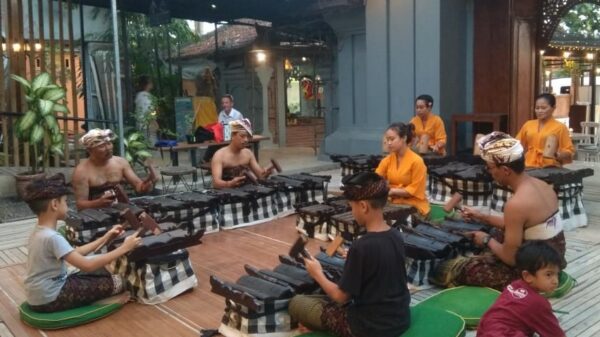
Mekar Bhuana is not an institution. It is a family compound — a garden, a pavilion, a kitchen, and rehearsal space that fills with sound most evenings. Guests sit on the same mats the players do.
We work on the older and rarer end of Balinese music: archaic ensembles, seven-tone tunings, instruments that had gone quiet in their own villages. Much of what we teach explains why the music sounds the way it does — the rice calendar, the ceremonies, the agrarian year that shaped it.
Because we are family-based, we do not take walk-ins. Everything is booked at least two weeks ahead, by email.
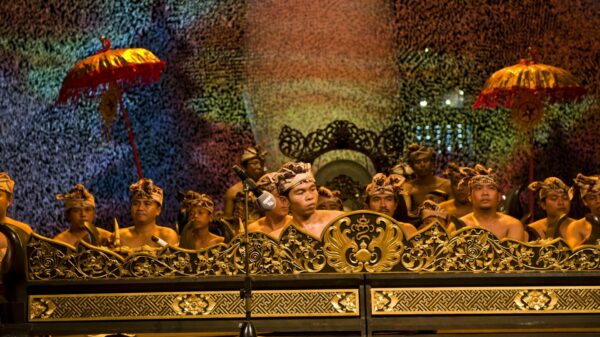
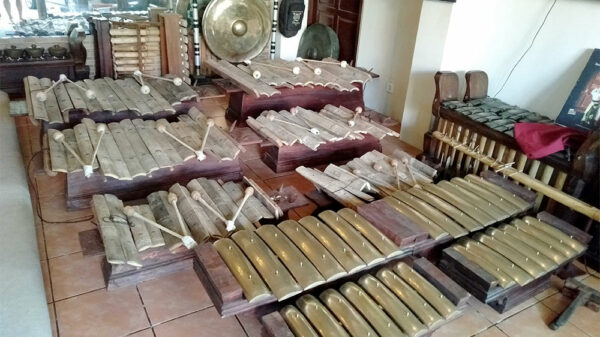
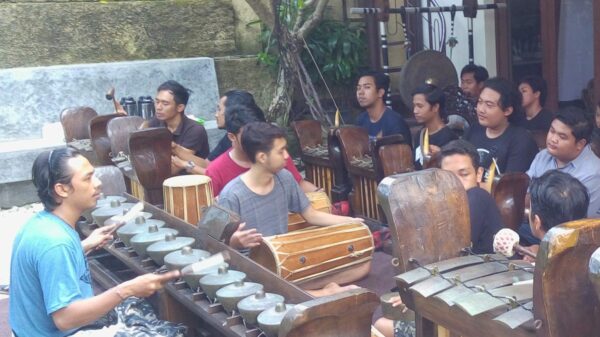
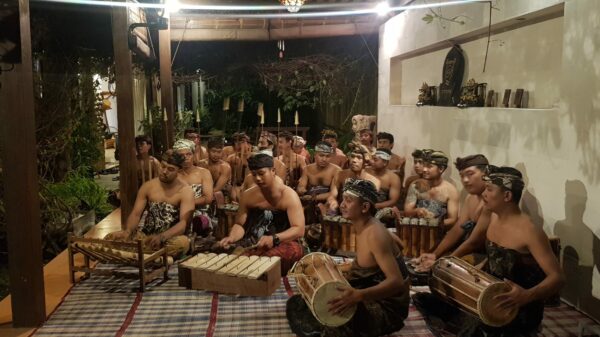
Every session is led by working musicians and dancers, with an English-speaking ethnomusicologist to explain what you’re hearing. Book at least two weeks ahead — we’re a home, not a venue.

Sixty minutes, one instrument, one teacher. Private or in a group you bring yourself.
From 60 min →
Two to four hours with two experts — history, sociology and playing, in that order.
2–4 hours →
Multi-day study-abroad programmes: gamelan, dance, puppetry, cooking, ceremony, a final performance.
Multi-day →
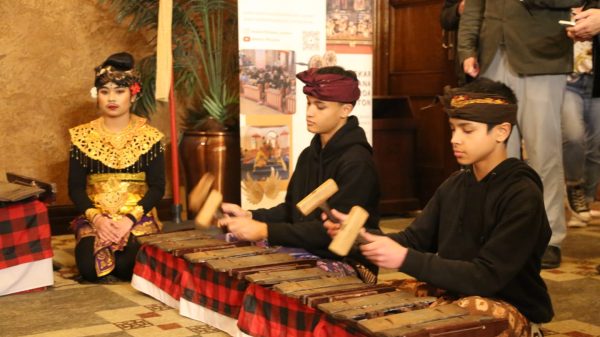
Built for mixed ages — children, teenagers and adults at the same set of instruments.
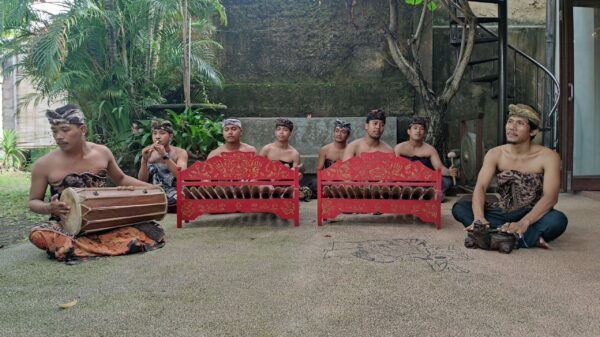
All ages →A pavilion, a walled garden, a studio and an outdoor rehearsal ground — attached to our house. Frangipani drops onto the gongs. The neighbours know the repertoire.
Twenty-two in Bali, five in Aotearoa. Several were rebuilt from a handful of surviving keys; one is the only ensemble of its kind outside Indonesia.
A very unusual angklung from Lombok, restored and reconstructed. Its four sweet-toned keys had lost the lowest one entirely — kirang means missing.

Modelled on the Bugbug formation — 48 keys, smaller and lower than the set in Bali, and the only one of its kind outside Indonesia.

Tuned higher than our Balinese set and built smaller — a different instrument to sit at, though the repertoire is the same.
Four hundred pages. More than a hundred ensembles — ancient to contemporary, popular to extinct — each with links to video and audio, read as a flipbook in English or Bahasa Indonesia.
Professional and semi-professional groups for festivals, openings, hotels and villas. Classical and archaic repertoire only — dance always with a full orchestra.
Performances →Speakers and consultants on Balinese gamelan, dance and culture for your event, seminar or university module.
Experts →Engineers who know where to put a microphone in front of bronze — multi-track or natural stereo, in our studio or on location.
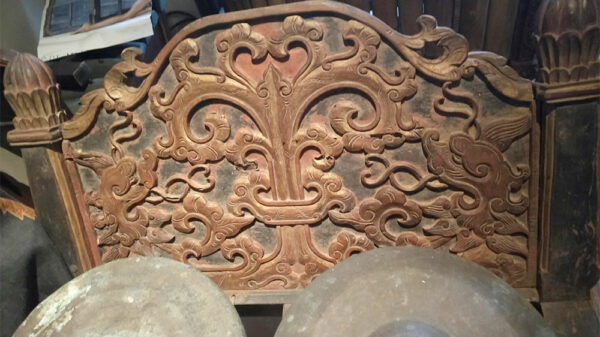
Recording →Four instruments, and only the original keys survive. The resonators, frames and carving all have to be rebuilt from scratch.
A historic ensemble with Chinese connections and rare instruments dating back to the early nineteenth century, waiting on a restoration budget.